Production AI
The KV Cache Is the Real Tenant of Your GPU
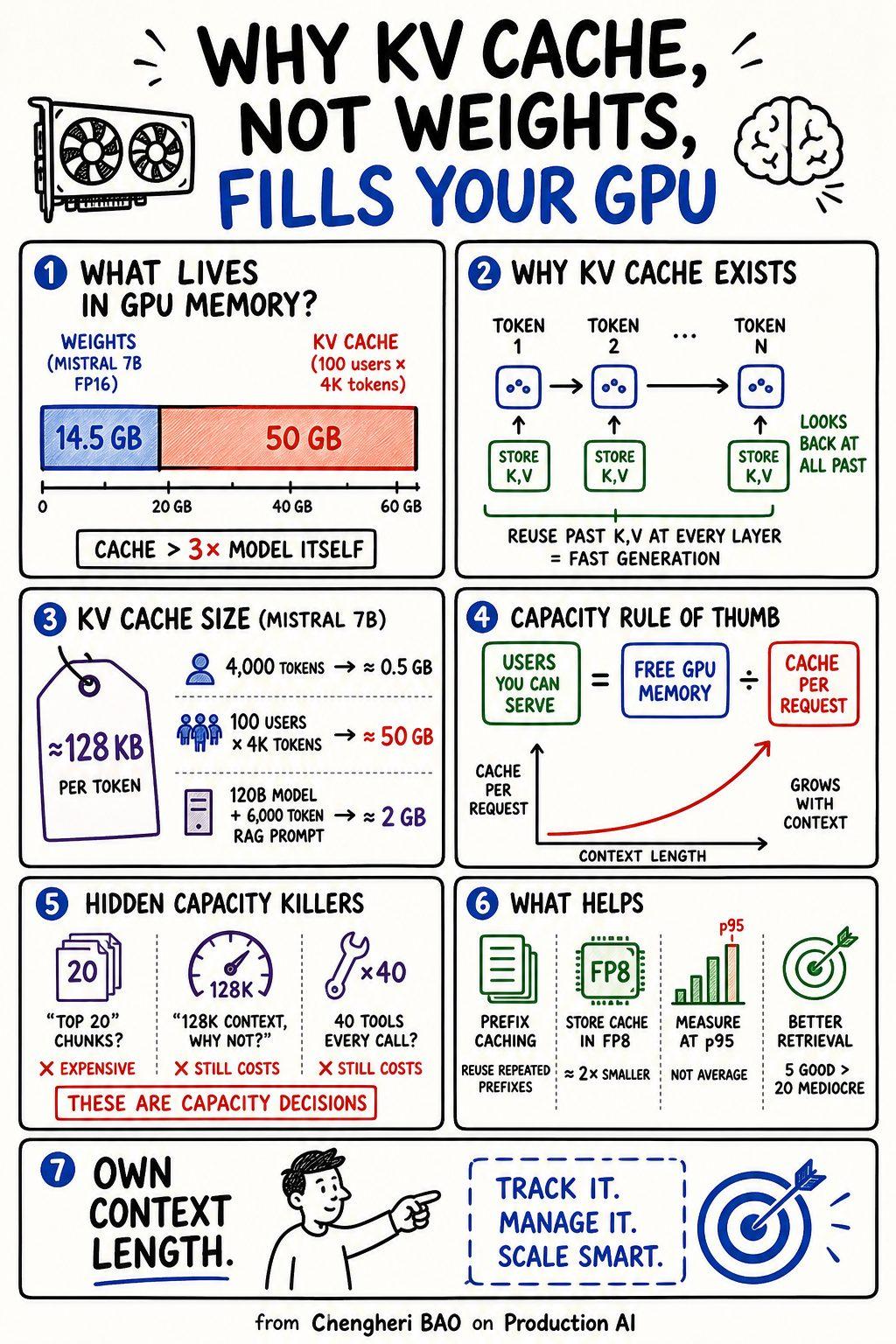
“Fits on the GPU” is usually the wrong question.
I’ve had teams tell me a model is fine because the weights fit.
Mistral 7B in FP16 is about 14.5 GB, so on paper it looks easy.
Then production starts, traffic rises, and the GPU fills up anyway.
The real tenant is the KV cache.
An LLM generates one token at a time.
To avoid recomputing the full conversation at every step, it stores keys and values for every past token, at every layer.
That cache lives in GPU memory, per user, for as long as the request runs.
For Mistral 7B, that’s roughly:
- 128 KB per token
- ~0.5 GB for a 4,000-token conversation
- ~50 GB for 100 concurrent users
- more than 3x the model itself
On a 120B model with a 6,000-token RAG prompt, the cache is about 2 GB per request.
So GPU capacity is not just “does the model fit?”
It’s “how much context can I afford, at what concurrency?”
What I watch closely:
- prefix caching for repeated system prompts and tool definitions
- FP8 KV cache when the stack supports it
- p95 context length, not averages
- retrieval quality: 5 good chunks beat 20 mediocre ones
This is why “send the top 20 chunks” is a capacity decision, not just a retrieval choice.
Who on your team owns context length?